
What is Blockchain-as-a-Service?
Blockchain is undoubtedly one of the most revolutionary technologies of the 21st century. The technology has enormous potential to disrupt many industries and has done so in the last decade. According to Gartner, blockchain will create business value worth $3.1 trillion.
However, it is not always possible to create, maintain, and manage a blockchain solution. This is where Blockchain-as-a-Service (BaaS) comes in. Companies including Amazon, Microsoft, Oracle, and others already offer this type of service. In the next few lines, I will explain what BaaS is and how it works.
What is Blockchain-as-a-Service
What is Blockchain-as-a-Service (BaaS)?
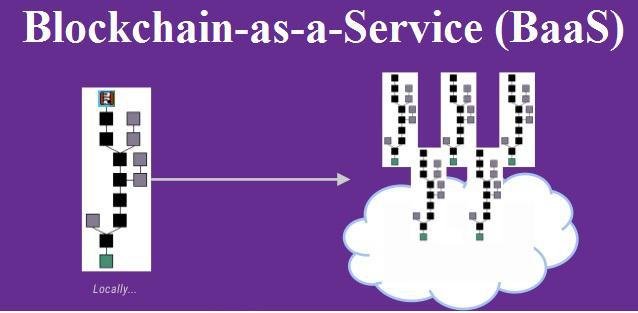
BaaS is a cloud-based service that enables customers to create their own blockchain-based products, including applications, smart contracts, and use other blockchain features without the need to set up, manage, or execute blockchain-based infrastructure. In other words, BaaS can simply be defined as an entity used to set up all necessary blockchain technologies for a given application. All you need to do is choose a reliable BaaS provider and leave the confusing backend business logic to them. It is based on the concept of the Software-as-a-Service (SaaS) model and works similarly.
How does BaaS work?
BaaS is when an external service provider sets up the necessary "blockchain technology and infrastructure" for the client at any cost. The client pays the BaaS provider to configure and maintain connected blockchain nodes on their behalf, and the BaaS provider handles the complex back-end for the client and their business.
Think of BaaS operation similar to a hosting service provider. You run your site on an external hosting service provider like Amazon Web Services and let them take care of all infrastructure and maintenance issues. This allows you to focus on the core functionality of the site.
Best BaaS Platforms for Enterprise Solutions
Microsoft Blockchain on Azure Platform
With the introduction of Microsoft's Blockchain-as-a-Service in 2015, a new path opened for companies wanting to familiarize themselves with the technology before investing significant resources in developing blockchain-based solutions. In 2017, Microsoft launched Enterprise Smart Contracts, which provide users with schema, logic, contractors, external sources, accounting, and binding agreements to build their own blockchain services. The platform is very user-friendly and enables one-click deployment, allowing companies to deploy blockchain network topology within minutes.
Amazon AWS Blockchain Templates
Launched almost a year ago in April 2018, Amazon's Blockchain Templates offer blockchain-as-a-service for Amazon Web Services, which facilitate the development of blockchain-based projects. The software allows users to build on two forms of distributed ledger technology – Ethereum or Hyperledger Fabric. The difference between these two centers is that Ethereum is aimed at public applications, while Hyperledger Fabric is more suitable for private cloud applications.
SAP Cloud Platform Blockchain
SAP's Blockchain-as-a-Service is called "Leonardo," which is based on Hyperledger and resides in SAP Cloud service. It can be accessed from any device and does not require on-premise hardware or software. SAP Leonardo operates as a Blockchain cloud service, machine learning service, and supports the Internet of Things (IoT) in one ecosystem.
Oracle Cloud Blocking Service
Oracle launched Oracle Blockchain Cloud Service as part of its extensive Platform-as-a-Service (PaaS) offering. Their blockchain service offers corporate clients a way to engage with blockchain through a fully managed approach. This Blockchain cloud service is also built on the Open Source Hyperledger Fabric project. Additionally, Oracle announced the launch of Oracle Blockchain Applications Cloud, a new suite of SaaS applications for specific use cases designed to improve supply chain traceability and transparency.
IBM Blockchain Platform
IBM's blockchain platform enables companies to quickly and economically create and manage a blockchain ecosystem on a flexible cloud-based platform. Some companies have already benefited from IBM blockchain services, including Walmart, which uses them to improve traceability and transparency in the food supply chain.
Huawei Blockchain Service
Chinese telecom giant Huawei launched a blockchain-as-a-service platform that is a highly available and secure blockchain platform, enabling enterprises and developers to conveniently create, deploy, and manage applications with excellent cloud performance and cost-effectiveness. Huawei's new blockchain solution is also based on Hyperledger Fabric open source code. The technology currently focuses on developing solutions related to supply chain, public services such as identity verification, financial audit, and assets with tokenized securities.